
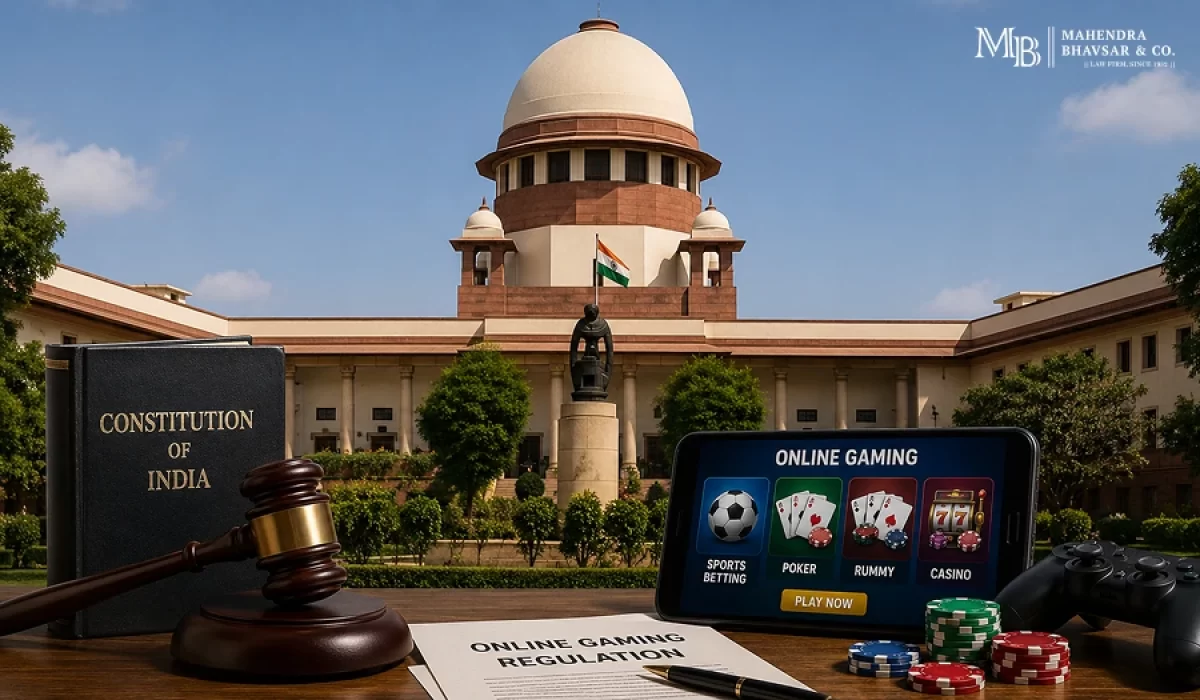
By Team @ Mahendra Bhavsar & Co.
Reviewed by: Mahendra Bhavsar & Co. Legal Team
Last Updated: 09 June 2026
Quick Answer
In State of Tamil Nadu v. Junglee Games India Pvt. Ltd. & connected matters, the Supreme Court examined constitutional challenges to online gaming laws enacted by Tamil Nadu and Karnataka. The case focused on whether States can regulate or prohibit online gaming involving betting or wagering and how Entry 34 of List II (“betting and gambling”) should be interpreted. The judgment addresses legislative competence, games of skill, online gaming with stakes, public order concerns and the constitutional limits of State regulation in the digital gaming sector.
Why This Judgment Matters
Online gaming has become one of India’s fastest-growing digital industries. At the same time, States have increasingly expressed concerns regarding addiction, financial loss, indebtedness and public welfare arising from online betting and wagering activities.
This case is significant because it considers whether traditional constitutional principles relating to gambling and games of skill apply equally in the online environment. It also examines whether State legislatures can regulate online gaming platforms through laws framed under their constitutional powers relating to betting and gambling.
For gaming operators, technology businesses, investors, regulators and lawyers, the judgment provides an important discussion on legislative competence, constitutional rights and the distinction between games of skill and gambling-related activities in cyberspace.
Brief Facts
Tamil Nadu enacted amendments in 2021 to regulate and prohibit online betting and wagering activities conducted through computers, mobile devices and cyberspace. The amendments expanded the definition of gaming and extended restrictions to wagering on games such as rummy and poker played online.
Karnataka also amended its gaming laws to regulate online gaming involving wagering or betting and to bring virtual platforms within the statutory framework governing gaming activities.
Several gaming companies challenged these laws before the Madras High Court and Karnataka High Court. The High Courts struck down significant portions of the legislation, holding that games of skill enjoy constitutional protection and that betting and gambling under Entry 34 could not be interpreted so broadly as to include all games played for stakes.
The States appealed to the Supreme Court, leading to a detailed examination of constitutional entries, online gaming regulation and the legal distinction between skill and chance.
Key Legal Issue
The Court considered several important questions, including:
1. Does Entry 34 (“betting and gambling”) permit States to regulate betting connected with games of skill?
2. Can online gaming involving stakes be regulated differently from traditional offline gaming?
3. Can State legislatures rely on public order, public health and related constitutional entries when regulating online gaming activities?
4. Are blanket restrictions on online gaming constitutionally permissible?
What the Court Held
Interpretation of Entry 34
A major controversy concerned the meaning of the constitutional expression “betting and gambling.” The States argued that betting should not be narrowly confined to games of chance and that wagering on uncertain outcomes could fall within State regulatory power. The gaming companies argued that games of skill remain distinct from gambling even when played for stakes.
Online Gaming and Public Concerns
The judgment records extensive submissions regarding online gaming addiction, financial distress and public welfare concerns. The States relied on material relating to addiction, indebtedness and social consequences arising from online betting activities to justify regulation.
Constitutional Competence
The Court examined whether State legislative competence arises only from Entry 34 or whether other entries such as public order, police powers, public health and entertainment-related entries may also support regulation of online gaming activities. This formed a substantial part of the constitutional analysis.
Digital Environment and Traditional Principles
The judgment recognised that online gaming presents challenges different from conventional physical gaming environments. The Court discussed how cyberspace, virtual platforms, mobile applications and internet-based participation have changed the scale and nature of gaming activities.
Games of Skill Versus Gambling
A central theme throughout the litigation was whether staking money on games involving skill alters their legal character. The competing submissions addressed long-standing precedents on games of skill, online rummy, poker and wagering activities. The Court’s analysis focused on constitutional interpretation rather than merely the technological medium through which games are played.
Practical Takeaways
- Gaming companies must closely monitor State-level regulation of online gaming.
- Constitutional protection arguments continue to be important in gaming litigation.
- Regulatory treatment may differ between games of chance and games of skill.
- Online platforms face increasing scrutiny regarding wagering and betting models.
- Policymakers may rely on public health and public order considerations when framing regulations.
- Businesses operating in multiple States should assess regulatory risks carefully.
What the Judgment Does Not Decide
- A universal regulatory framework for all online gaming in India.
- The legality of every individual gaming format.
- Whether every online skill game is automatically protected.
- The future validity of all State gaming legislation.
- Specific compliance requirements for every gaming platform.
Short Ratio
The Supreme Court undertook a detailed examination of the constitutional scope of State power over online gaming, betting and wagering activities. The judgment analyses Entry 34 and related constitutional entries while addressing how traditional gaming principles apply within modern digital and online environments.
FAQs:
1. What was the main issue before the Supreme Court in this online gaming case?
The primary issue concerned the constitutional validity of State laws regulating online gaming, betting and wagering activities and the extent of State legislative power under Entry 34 relating to betting and gambling.
2. Did the case involve online rummy and poker?
Yes. The litigation included challenges relating to the treatment of online rummy and poker under Tamil Nadu legislation and the broader question of whether such games could be regulated as gambling-related activities.
3. Why is Entry 34 important?
Entry 34 of List II deals with betting and gambling. The case required the Court to examine how broadly that constitutional entry should be interpreted in the context of modern online gaming platforms.
4. Did the judgment discuss public health and addiction concerns?
Yes. The States relied on concerns relating to gaming addiction, financial distress and public welfare to support their regulatory measures. These issues formed part of the constitutional debate before the Court.
5. Why is the judgment relevant for gaming companies?
The case addresses legislative competence, regulatory powers, online gaming business models and constitutional protections that may affect operators across India’s digital gaming industry.
Stay informed with insights that matter. Follow us for more updates on key legal developments.
Disclaimer
The content provided here is for general information only; it does not constitute legal advice. Reading them does not create a lawyer-client relationship, and Mahendra Bhavsar & Co. disclaims all liability for actions taken or omitted based on this content. Always obtain advice from qualified counsel for your specific circumstances. © Mahendra Bhavsar & Co.